
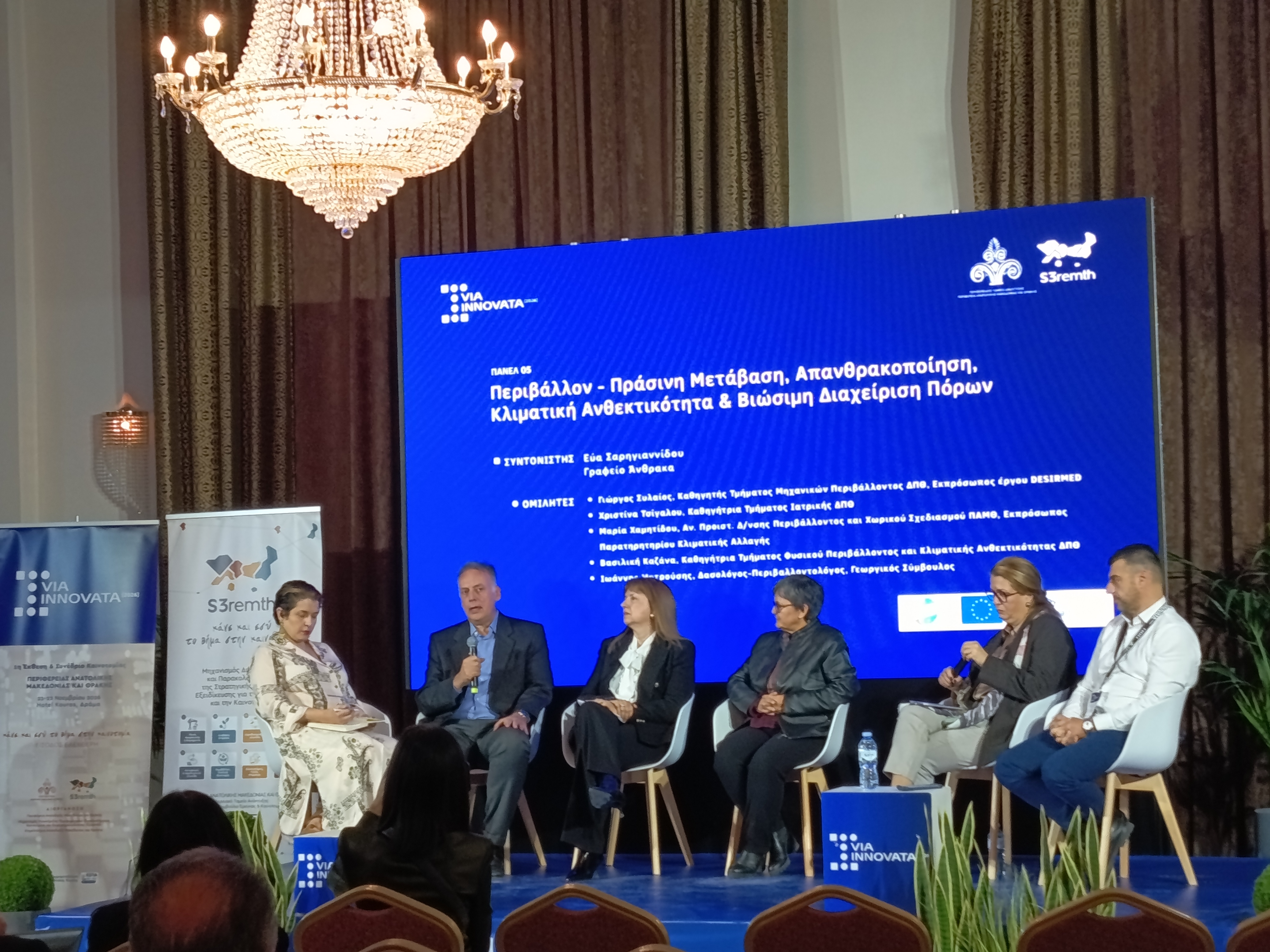
DesirMED was represented by Prof. Georgios Sylaios of the Democritus University of Thrace (DUTH) at VIA INNOVATA 2026, the first Innovation Exhibition and Conference of the Region of Eastern Macedonia and Thrace, held on 21–22 November in Drama, Greece.
As a speaker in the panel “Environment, Green Transition, Decarbonisation, Climate Resilience and Sustainable Resource Management”, Prof. Sylaios presented DesirMED as an example of how research and innovation can be translated into practical climate adaptation measures tailored to local needs and territorial characteristics.
The presentation focused on the four pilot actions being developed and implemented by the Eastern Macedonia and Thrace Regional Cluster and their contribution to the Region’s climate adaptation objectives. These included: precision irrigation combined with inter-row vegetation management to improve water and soil conservation in vineyards; check dams for reducing flash-flood risk; constructed wetlands for wastewater treatment and water reuse; and nature-based coastal protection measures combining geotextile structures with seagrass restoration.
Emphasis was placed on the importance of place-based solutions, ensuring that interventions respond to local environmental conditions, socio-economic priorities and stakeholder needs. The discussion highlighted that close cooperation with regional and local authorities, farmers and other stakeholders is essential for translating innovative concepts into tangible benefits on the ground.
The event also provided an opportunity to present the broader DesirMED framework, showcasing how cooperation among five Demonstrating Regions and three Replicating Regions supports the exchange of knowledge, the testing of innovative solutions and development of practical pathways towards climate resilience. It underlined the value of collaboration among universities, public authorities, businesses and civil society in accelerating the uptake of adaptation solutions.
Finally, attention was drawn to the potential for scaling up and mainstreaming the demonstrated solutions through regional policies, investment programmes and long-term land and water management strategies. The key message emerging from the discussion was clear: building climate resilience requires not only innovative solutions, but also strong local partnerships and their effective integration into regional development priorities.


